Saturday, August 30, 2008

King Charlemagne


Charlemagne was born in April 747 and died on January 28, 814. The place where Charlemagne was born is unknown historians. He was best known as the Frankish king and the Holy Roman Emperor. He was the Frankish king who conquered most of Europe and was crowned Holy Roman Emperor in 800. Charlemagne united most of Europe and created a period of order during the Middle Ages. He was the first Germanic ruler to get the title of emperor. Charlemagne left his mark on the newly rising civilization of the West. He was the son of Pepin the Short and the grandson of Charles Martel. From 768 to 771, Charlemagne shared the kingdom with his brother, Carloman. When Carloman died, He became the main ruler.

Charlemagne became a giant figure in the western world especially in Europe during all his reign and even after his death, he would never be forgotten. Though Charlemagne's empire was very great, it did not replace the lost government of Rome. He contributed to the Early Middle Ages because of his concern with law. His main goal was to reform the legal system in the Frankish empire. He had eventually strengthened the feudal, political, and economic systems. Charlemagne appeared to be both a Christian and barbarian leader and emperor. Though it was said, that he was a Christian emperor, he was very brutal and violent. Though he was a Christian, he had no ideal of what Christianity was really about. ( Middle Ages 171, 172 & The Early Middle Ages 56, 57)

Charlemagne married the daughter of the Lombard king Desiderius in 770 in order to maintan an alliance with each other. When his brother dies, he sent his wife back to the Lombard king and began to expand his empire by attacking the Lombards. By the year 774, He had defeated his father-in-law and had gained control of northern Italy. Charlemagne had one of the best intelligence networks of the time, he sent out spies and scouts to determine locations of his enemies. He often divided his army into two columns and reunited them at the minute of the attack. Charlemagne's army were almost always successful because of their number and individual abilities.


Charlemagne was the most powerful ruler of Western Europe and the realm he had conquered covered what are now France, Switzerland, Belgium, and The Netherlands. Charlemagne restored much of the unity of the old Roman Empire and brought much of the development to modern Europe. On Christmas Day in 800, while Charlemagne knelt in prayer in Saint Peter's in Rome, was crowned King. The church shouted, " great and pacific emperor, long life and victory." He is considered the first Holy Roman emperor , and got the title Charles the Great, though he did not use it.

In 811, Charlemagne began the march to Verden to meet Godefrid, the king of the Norsemen. Before Charlemagne and Godefrid could meet for battle, Godefrid was murdered. Charlemagne was now seventy years old and when he heard news of what had happened, began the trip back home. This would be his last expedition. In 813, his health became very bad, so he gave his power and empire to his son Louis and less than a year later, he was dead.

Cantor, Norman. The Civilization of the Middle Ages. New York: HarpersCollins Publishers Inc. 1963
Corrick, James. The Early Middle Ages. San Diego: Lucent Books, Inc. 1995

Thanks for letting me turn this in late Mr lockwood!!!!!!!

Wednesday, August 20, 2008

The Middle Ages: The black death

The Middle Ages have many interesting parts to it. The one I found most interesting was the time during the Black death. The Black Death reached the shores of Italy in 1348, unleashing a huge percent of death across Europe. By the end of the three year period, 25% to 50% of people had been affected or killed by the plague. The plague was spread by fleas that attached themselves to rats who then attached themselves to humans which caused the time of the black death.

The plague was in three forms. The bubonic variant which was the most common of them was the swellings that appeared on a person's neck, armpits, or groin. These tumors ranged in size from the size an egg to the size of an apple. Some survived the painful time but usually the person had a life expectancy of up to a week. Infected fleas that attached themselves to rats and then to humans spread this bubonic type of the plague. The second type was the pneumonic plague, it attacked the respiratory system and could be spread just by breathing the exhaled air of a sick person. It was much more life threatening, a person only lived up to one to two days. And the last one was the septicemic version of the disease which affected the blood system. The population decreased because of the plague and this eventually led to an economic depression. Merchants and tradesmen had less and less people to whom they could sell their items too. The economic hardship spread throughout the community and made a huge effect on all of the people. The only ones who could avoid the disease and hardship were those who were wealthy and could travel and leave the city for the country.

I think this time, during the middle ages is so interesting because it shows me what the people had to deal with and go through. Its also interesting because, it goes to show me that I should be thankful for the technology we have and for the medical system we have today. There were many effects from the plague. One was that art was greatly affected by the plague. During the time of panic and fear, artists were inspired to draw and their drawings reflected what they were going through. Therefore the plague benefited art. Another thing that was effected was the way people looked at children after this. After this time children were not considered important and not worth the trouble. It took Europe four hundred years to regain the same population before the Black death.

I think the black death was interesting because i found out that scientists think the plague and HiV are similar. I also learned that though many people died from this disease, some survived. For a disease to infect a human body there must be a gateway through which the disease enters into human cells. The plague works by attacking the white blood cells sent to fight it off. It then travels inside the white blood cells to the lymph nodes. From there the bacteria breaks out and attacks the immune system. It is said that maybe, CCR5 gene or delta 32, may have prevented the disease from being able to enter a person's white blood cells. This topic really held my interest and showed me things from the past can be linked to things in the present time.

There were many reasons to why the plague was worse than it might have been. Europe was too overcrowded, the cities were crowded with people living in unsanitary conditions. Their bedding was made from straw which provided a perfect nesting place for rats and the fleas. In general conditions of health were very poor.Also the food supply could not keep pace with the population growth. The result of this was a series of devastating famines that had left Europeans weak and vulnerable to a any kind of diseases. The plague did not entirely disappear but instead had occasional local outbreaks, especially in central Asia. When it did return it create a widespread of panic in populations. Social order was weakened under the stress, and the hungry and exhausted people became more vulnerable to this plague or any plague for that matter. ( bookrag and online book/ encyclopedia)

Online book: http://www.bookrags.com/history/black-death-hf/sub6.html
online book/ encyclopedia: http://www.deathreference.com/Bl-Ce/Black-Death.html

Saturday, May 24, 2008

My overall impression of the class

My overall impressions of the class was that this year was my favorite year being in your class Mr. Lockwood. I have learned so much in your class, though it may seem I haven't, I really have. I definitely understood a lot more this year then some of the past years. All the different civilizations and ways of life we learned about really kept me very interested. I really appreciated how you went through all the chapters with us and also how once in a while you had given us what was going to be on the quiz.

History class this year, I think really was beneficial to me cause everything we learned made sense and I learned so much. The topics were very interesting and I think the overall outcome of this year was for the most part very organized and educational. I liked how we read the book together and how we had discussions about it. Also how we watched movies to give us even more information on the subject was also very helpful too. Some of my favorite movies were about the gladiators and Pompeii. Both kept me really interested and I really enjoyed watching them.

Something I think that could be improved or fixed was the quiz and test dates. They were set for a certain date but then when that day, we didn't end up taking it. It was kinda frustrating studying for the quizzes and tests and then not taking it that same day and having to restudy it again. Other than this everything went smoothly. I found that towards the middle of the year that my quiz and tests scores were a lot better when you told us what was gonna be on it. From you doing this I now feel like I know what to expect on the quizzes and tests.

As for the blogs I think these were very helpful as well, they gave us another source to the topic we were on. Concerning the blogs I would say that maybe we could have them every other week instead of each week. But I do prefer doing these over a huge report every semester. I also think that maybe if we couldn't have them every other week, then perhaps they could be due on Sunday at like 2:00 pm. But other then that I have enjoyed doing the blogs.

This year was overall very productive and educational. I'm definitely looking forward to next year and In hope it is just as good. I would say my overall impression of this class was that it was an awesome year. I'm looking forward to another great year being in your class. The material we learned this year wasn't just history to me, I really enjoyed learning about it.

Saturday, May 17, 2008

Islam and Christianity


Islam and Christianity both are considered monotheistic religions because both believe in one God. Both Islam and Christianity recognize that there God as the Creator of the world. Another similarity is that God is omnipotent and immanent within His creation yet he is transcendent. Christianity and Islam believe in many of the same things, but they do have differences within each one. The main difference between Islam and Christianity is that Muhammad isn't considered divine but Jesus is. Within Islam, Jesus is considered a prophet but not the son of God. They believe that Muhammad was the last prophet or messenger of God. Another main difference is that Muslims see no separation between their religion and political authority but Christianity sees this situation completely different. (Discussion/Movie notes)

Christianity believes that there is only one true God and that people are to worship him only. This is the same within Islam. It is said that both believe that Jesus died on the cross but that the Muslims don't believe he rose from the dead. Within that situation, the people of Islam believed that Allah tricked them and put another man in his place. Christians believe in the Bible and the Muslims believe in the Koran. Christianity believes that God gave and presented his word in the Bible. Islam however, believes that Allah has given his eternal, uncreated Koran or Quran to the Muslim people.

Christianity and Islam both, believe that Satan exists, as well as evil spirits and that they are known as enemies to mankind. Another main difference is that Islam does not believe in the trinity but Christianity does. The Islamic people believe Jesus and Muhammad both were a Prophet and a servant of God but that Muhammad was the last Prophet sent by God to guide the people. Prayer was one of the most important things to Christians and Muslims. They believe prayer is a way of communicating with God and how God hears our prayers and sometimes grants what we ask of him. Something I found quite interesting was that not only does Christianity believe in faith without works is dead but so does Islam. My question is how could two religions who believe in the same God, have totally different ways of life? The majority of rituals and beliefs within each religion are quite different from each other. The main theological differences between Christianity and Islam were that both had different beliefs within the religion, different views of God, and different views of Creation. (bookrags)

The people of Islam believe that when we die we will go to barzakh, an interim afterlife, where we will wait until Judgment Day. But Christians believe that when we die, we are immediately judged and sent to Heaven or Hell, this is based on whether we excepted Christ or not. As I already had said, that Christians believe in the trinity, the Muslims believe in indivisible. It is mandatory for Muslims to face Mecca and prayer five times every day but as for Christians we have no such obligation of this.

From doing this blog I have learned that there is far more similarties between Islam and Christianity but at the same time there are many differences. Though there are a few similarities between Islam and Christianity, Muslims do not believe in that Jesus was the son of God, though they believe him to have been a prophet, they are missing the main purpose of who he is. F Muslims do not hold to any assurance of salvation and therefore they do not feel that it is necessary for Jesus to pay for their sins. Instead Muslims believe that every man must pay for his or her own sins; and that for Jesus to be punished for our sins would be unjust. Christians however, believe that man had no ability to pay for his sins alone because without God's grace we cannot be saved.
Movie/ Discussion notes
Bookrags: online book:http://www.bookrags.com/essay-2004/5/11/18575/1149

Saturday, May 10, 2008

The Muslim conquest of Byzantium


Byzantium is the name for both the state and the culture of the Eastern Roman Empire during the middle ages. The Byzantium Empire's capital city was Constantinople. The Byzantine civilization did once constitute a major world culture. Constantinople, had been founded as the capital of Rome by the Emperor Constantine.

Almost all of Byzantine energy would be focused on Islam during the next few centuries to come. The Muslims very quickly conquered Byzantine territory in Syria and Egypt mainly because of disaffected populations of Christians and Jews who had been persecuted for such a long time. They easily conquered all the Persian territories, but they could never all together conquer the heart of Byzantium itself. In 670, the Muslims attempted this conquest with a huge fleet, but failed. Then in 717, they tried again with a land and sea operation against the city.

By the end of Muhammad's time, the Muslims were raiding into Byzantine territory in Syria and were beginning to conquer the Persian territories. The first conquests took place under the caliph Abu Bakr. The very first conquest took place in 633-634. The general Yazid defeated the Byzantine commander Sergios at Gaza and from here on the Muslims took over places within the Byzantine Empire. It is important to know that when we speak about the fall of the Byzantine Empire, that we understand that the western side fell not the eastern. The 2nd great civilization was that of the rise of Islam and the Islamic civilization which was religious and had developed from the teachings of the prophet Muhammad. The Muslims quite quickly then moved to Egypt and defeated the Egyptians there and took it over.

The spread of Islam began to grow after the death of Muhammad in 632. The Islamic conquest of Persia led to the end of the Sassanid Empire and the later led to the decline of the Zoroastrian religion. The achievements of the Persian civilizations were not completely lost, but were absorbed basically by the new Islamic religion. Islam was a religion that spread like a wildfire through out the known world. The new growing religion began to pull in many followers who then became very dedicated to their new faith. The religion Islam spread into one of the world's greatest empires, which was the Byzantine Empire. Byzantium was known was a Roman city that was basically made up of Christians and Jews. I believe why Byzantium fell was because the Islamic religion was so powerful and the fact that the empire had already began to weaken, made it easier for any outside force to attack it. ( Movie/ Discussion notes)

Syria was conquered by Muslim forces. Jerusalem falls to invading Muslim forces. And later in Egypt, Islam also spread. This goes to show us that Islam was a very dangerous religion. Since it was such a new growing religion it catch people eye. The Muslims when they moved in to attack a different area would give the people like the Christians or jews a choice to convert or pay a tax. Many chose to just pay a tax, but as the money roled in, new problems arose. The problems were that everybody wanted their own share of the money and this led to more problems. Finally in 714, the French stopped The muslims . (Online book)

Movie/ Discussion)
Online source: http://atheism.about.com/library/FAQs/christian/blchron_xian_crusades01.htm

Friday, May 2, 2008

The two main sects of Islam


The Muslim world is divided into two main sects the: Shite and Sunni. Though both follow the same belief, they differ by two points, one is the succession to the Prophet Muhammad, and the other is religious authority in Islam after him. Most of the Muslims belong to the Sunni. The biggest difference between the two is the Caliph of each one.

The Shi'ites split with the Sunni over the issue of the successor to Muhammad. The split occurred after the assassination of the fourth caliph in 661. Shi'ites believe that the successor to Muhammad should have been Ali, his son in law. They believe that they alone are right in their understanding of Islam. They call themselves al-Muminun, or the "true believers."They do not believe in the six correct books but instead have five of their own. Shiites are huge in Iran, where they have deposed the Shah and installed the Ayatollah Khomeini. They have also enforced Islamic law as the rule of the government.

The Islamic religion has many sects and branches. But the largest one is the Sunni. The Sunnis Muslims believe that after Muhammad's death when the confusion ensued from not having a person to head the community, led to the election of Abu Bakr, the Prophet's father-in-law, who became the first Caliph. The Sunni and Shiites did slit but even within the Sunni there is problems. There are some liberal and more secular movements in Sunni Islam that say that Shari'a is interpreted on a basis. They reject any religious edict by religious Muslim authority figures. The Sunni is the dominant form of Islam, captivating over 90% of Muslims worldwide then and today. The Sunni and Shi’a both believe in the oneness of God, the revelations of Mohammad, and resurrection of the day or judgment. But other then that, they totally believe in opposite ways of life. Shi’a believe the leadership of Islam must come from descendants of Mohammad, and grant their spiritual leaders,more power than Sunni sects.

The difference between those both sects is that within Islam initially stemmed not from spiritual differences, but political ones. The word Sunni comes from a Arabic word meaning "one who follows the traditions of the Prophet." The Sunni Muslims focus a lot on the Prophet Muhammad and the Shiites focus less on the Prophet. The word "Shia" in Arabic means a group or supportive party of people. I think that if both sects hadn't split then we may have not been here today. The Sunni Islam is also referred as Sunnism. They represent the branch of Islam that accepted the caliphate of Abu Bakr due to him being chosen by Shurah. Shurah is the first distinguishing factor of Sunni Islam. (Bookrags)

Muhammad died in 632, then Abu Bakr, who was a close companion of the Prophet, became his successor, or caliph. Muslims agree that the most able of the Prophet's followers should be his caliphs. Their followers would come to be known as the orthodox branch of Islam or later on the Sunnis. Sunnis accept the first four Caliphs, which included Ali, who were the rightful followers of Muhammad. But the Shiites believe imams are descendants of the Prophet. This is another way each sect differs from each other. (Source)
Online book: Bookrags: http://www.bookrags.com/wiki/Sunni_Islam
Online book/ source:http://middleeast.about.com/od/religionsectarianism/a/me070907sunnis.htm

Saturday, April 26, 2008

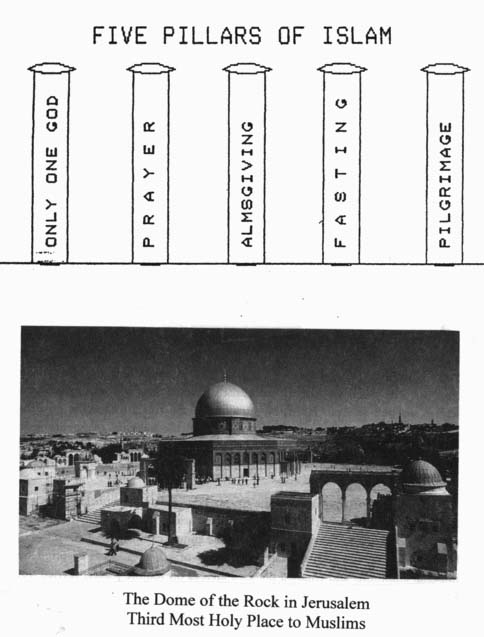
The 5 pillars of Islam


There are over a billion people who believe in Islam. One out of every five people believe in it. The whole Islamic religion focuses on on the Kabba in Mecca. Mecca is the birth place of Islam. The five pillars of the Islamic religion are the Shahadah, Salah, Zakah, Sawm, and the Hajj. The five pillars of Islam are formal acts of worship to the god Allah. The Muslims don't believe that Jesus was the last prophet, they believe Muhammad was. These five pillars are exercises of the faith. ( Islam

The first pillar of Islam is Shahadah which means the declaration of faith that there is one god and that Muhammad was the last messenger of the god Allah. It is the Muslim faith in there one and only god Allah. The Shahadah says in Arabic, "La ilaha ill'Allah, Muhammad rasul Allah", which means that there is no god but Allah and Muhammad is his messenger. The first pillar is the worship of Allah alone.

The second pillar of Islam is Salah. This pillar required a true Muslim to pray five times a day facing Mecca. The person bows, kneels, and then places his or her head on the ground. Before they begin to pray one must purify there body with water or sand. The prayer usually starts like this, "Praise be to God, Lord of the Universe!, The compassionate, the Merciful, King of the Day of Judgment!. You alone we worship, and to you alone we turn for help. Guide us to the straight path, The path of those whom You have favored, Not of those who have incurred Your wrath, Nor of those who have gone astray".

The third pillar of Islam is Zakah which was that a Muslim was to give to the poor and give regularly to charity. One of the most important principles of Islam is that all things belong to God. The word zakat means "purification." This pillar says that you must give a average amount of money to those who are poor and to charity. Though if someone could not give money, it was considered okay. Zakah helped keep money flowing within the society.

The fourth pillar of Islam was Sawm or fasting. Every year in the month of Ramada-n, all Muslims fast from dawn until sundown, fasting from food, drink, and sexual relations with people. If those who were sick, on a journey, elderly or women who were pregnant were permitted to break the fast and make up the number of days later in the year when they were healthy or able. This fasting time was not only for purification but it was also there health.

The fifth pillar was the Hajj which was the pilgrimage to Mecca or in other words the trip to Mecca. To go to Mecca you must be a Muslim, for it was the holy time to worship Allah. Usually Muslims who traveled to Mecca went in a group of people. Muslims have been going to Mecca for many years now and each one is required to go there at least on or twice in his or her lifetime. The journey made to Mecca is mandatory for all who are able to go. Without going to Mecca, Muslims do not fulfill all the five pillars.

Movie notes: Islam people, culture, and conflict
Online book: http://www.bookrags.com/wiki/Hajj