Friday, May 2, 2008

The two main sects of Islam


The Muslim world is divided into two main sects the: Shite and Sunni. Though both follow the same belief, they differ by two points, one is the succession to the Prophet Muhammad, and the other is religious authority in Islam after him. Most of the Muslims belong to the Sunni. The biggest difference between the two is the Caliph of each one.

The Shi'ites split with the Sunni over the issue of the successor to Muhammad. The split occurred after the assassination of the fourth caliph in 661. Shi'ites believe that the successor to Muhammad should have been Ali, his son in law. They believe that they alone are right in their understanding of Islam. They call themselves al-Muminun, or the "true believers."They do not believe in the six correct books but instead have five of their own. Shiites are huge in Iran, where they have deposed the Shah and installed the Ayatollah Khomeini. They have also enforced Islamic law as the rule of the government.

The Islamic religion has many sects and branches. But the largest one is the Sunni. The Sunnis Muslims believe that after Muhammad's death when the confusion ensued from not having a person to head the community, led to the election of Abu Bakr, the Prophet's father-in-law, who became the first Caliph. The Sunni and Shiites did slit but even within the Sunni there is problems. There are some liberal and more secular movements in Sunni Islam that say that Shari'a is interpreted on a basis. They reject any religious edict by religious Muslim authority figures. The Sunni is the dominant form of Islam, captivating over 90% of Muslims worldwide then and today. The Sunni and Shi’a both believe in the oneness of God, the revelations of Mohammad, and resurrection of the day or judgment. But other then that, they totally believe in opposite ways of life. Shi’a believe the leadership of Islam must come from descendants of Mohammad, and grant their spiritual leaders,more power than Sunni sects.

The difference between those both sects is that within Islam initially stemmed not from spiritual differences, but political ones. The word Sunni comes from a Arabic word meaning "one who follows the traditions of the Prophet." The Sunni Muslims focus a lot on the Prophet Muhammad and the Shiites focus less on the Prophet. The word "Shia" in Arabic means a group or supportive party of people. I think that if both sects hadn't split then we may have not been here today. The Sunni Islam is also referred as Sunnism. They represent the branch of Islam that accepted the caliphate of Abu Bakr due to him being chosen by Shurah. Shurah is the first distinguishing factor of Sunni Islam. (Bookrags)

Muhammad died in 632, then Abu Bakr, who was a close companion of the Prophet, became his successor, or caliph. Muslims agree that the most able of the Prophet's followers should be his caliphs. Their followers would come to be known as the orthodox branch of Islam or later on the Sunnis. Sunnis accept the first four Caliphs, which included Ali, who were the rightful followers of Muhammad. But the Shiites believe imams are descendants of the Prophet. This is another way each sect differs from each other. (Source)
Online book: Bookrags: http://www.bookrags.com/wiki/Sunni_Islam
Online book/ source:http://middleeast.about.com/od/religionsectarianism/a/me070907sunnis.htm

Saturday, April 26, 2008

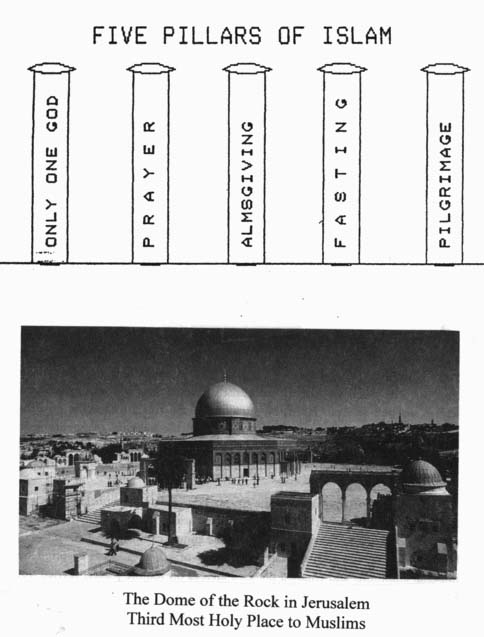
The 5 pillars of Islam


There are over a billion people who believe in Islam. One out of every five people believe in it. The whole Islamic religion focuses on on the Kabba in Mecca. Mecca is the birth place of Islam. The five pillars of the Islamic religion are the Shahadah, Salah, Zakah, Sawm, and the Hajj. The five pillars of Islam are formal acts of worship to the god Allah. The Muslims don't believe that Jesus was the last prophet, they believe Muhammad was. These five pillars are exercises of the faith. ( Islam

The first pillar of Islam is Shahadah which means the declaration of faith that there is one god and that Muhammad was the last messenger of the god Allah. It is the Muslim faith in there one and only god Allah. The Shahadah says in Arabic, "La ilaha ill'Allah, Muhammad rasul Allah", which means that there is no god but Allah and Muhammad is his messenger. The first pillar is the worship of Allah alone.

The second pillar of Islam is Salah. This pillar required a true Muslim to pray five times a day facing Mecca. The person bows, kneels, and then places his or her head on the ground. Before they begin to pray one must purify there body with water or sand. The prayer usually starts like this, "Praise be to God, Lord of the Universe!, The compassionate, the Merciful, King of the Day of Judgment!. You alone we worship, and to you alone we turn for help. Guide us to the straight path, The path of those whom You have favored, Not of those who have incurred Your wrath, Nor of those who have gone astray".

The third pillar of Islam is Zakah which was that a Muslim was to give to the poor and give regularly to charity. One of the most important principles of Islam is that all things belong to God. The word zakat means "purification." This pillar says that you must give a average amount of money to those who are poor and to charity. Though if someone could not give money, it was considered okay. Zakah helped keep money flowing within the society.

The fourth pillar of Islam was Sawm or fasting. Every year in the month of Ramada-n, all Muslims fast from dawn until sundown, fasting from food, drink, and sexual relations with people. If those who were sick, on a journey, elderly or women who were pregnant were permitted to break the fast and make up the number of days later in the year when they were healthy or able. This fasting time was not only for purification but it was also there health.

The fifth pillar was the Hajj which was the pilgrimage to Mecca or in other words the trip to Mecca. To go to Mecca you must be a Muslim, for it was the holy time to worship Allah. Usually Muslims who traveled to Mecca went in a group of people. Muslims have been going to Mecca for many years now and each one is required to go there at least on or twice in his or her lifetime. The journey made to Mecca is mandatory for all who are able to go. Without going to Mecca, Muslims do not fulfill all the five pillars.

Movie notes: Islam people, culture, and conflict
Online book: http://www.bookrags.com/wiki/Hajj

Sunday, March 9, 2008

How Rome fell and Gibbons explanations


There were many reasons to why the Roman empire fell. The most common one that is known is that the fall of Rome was because of Christianity. The reason why so many blame Christianity as the fall of Rome is because the religion caused the Roman citizens to become Pacifists which made it more difficult to defend the empire against attacks. Crime started to break out in the streets, especially violence which made the bigger cities in Rome unsafe which weakened the empire. Another reason why Rome fell was their public health. The Colosseum was a place where entertainment and games were held but from the blood and death, disease spread. Those that lived on the streets were more vulnerable to get the disease because of the widespread of diseases that swept through the streets. Another reason that caused Rome to fall was the difficulty of choosing another emperor. During a 100 year period, Rome had about 37 emperors and 25 of them were removed by assassination. This caused the overall weakness of the empire.

It didn't take the Goths and Germans very long to realize that Rome was becoming weak. They also realized that he new emperors were weak and so they knew then was the time to attack. Many Roman generals saw this and began to revolt. The Visigoths marched into Rome and took over the city. They sacked the city and took what they wanted. Anyone who crossed them, they killed. The results of this made the Romans wonder how could this happen to us and they began to wonder if the gods were angry with them. The Visigoths didn't stay in Rome for very long instead they moved on toward Italy.

The late economic collapse resulted in hyper-inflation. And from this various problems aroused from from the raising of taxation. The emperors lived luxuries lives and from this it resulted in that the government had no money. When the emperors wanted something they increased taxation. Gibbon said that the only reason why Rome fell was because of Christianity corrupting it. He said it weakened the bonds that held the Roman Empire together. But what Gibbon failed to realize was that there were many causes that weakened the empire which then led to the fall of Rome. I don't agree with Gibbon's explanation because wouldn't Christianity help the Roman society and wouldn't it benefit to it. When the empire fell, bad things came of it, the sacking of Rome, the destruction of art, the withering of great cities, the design of the system of roads, and much more. But because of the fall of Rome, it led to the abolition of slavery in Europe.

The date that most historians believe to be the day Rome fell was on September 4 476. Some historians believe that Rome could have survived if the circumstances were different. But it is said that Rome brought the decline among themselves. Edward Gibbon wrote," If a man were called upon to fix the period in the history of the world when the condition of the human race was most happy and prosperous, he would, without hesitation, name that which elapsed from the death of Domitian to the accession of Commodus." Yes this was a time where the Romans prospered and had great stability but still in the end it led to the fall of it. Rome had many reason to why it fell, so by Gibbon only giving one explanation to why it fell doesn't give us the complete look of what happened. (Bookrags)

Another reason to why Rome fell was because of the unity that was lost between the Romans. Every Roman wanted power and wanted to be remembered after they died. Half the time the Roman army would be fighting against each other to gain power rather then defending the empire. Rome came to a point when it was spending so much that they couldn't even afford it. This led to economic problems. This sounds so familiar to our society today, buying so much that we can't afford. It is said that our society today is following in the foot steps of Rome. All these things weakened the empire to the point in which it fell. The reason to why I believe Gibbon thought Christianity was the main reason to why Rome fell was because the church was spending so much of Rome's money. And he believed that it made the Romans stop caring about each other and it put Rome in a position of confusion. He thought that the money spent on the church could be used for the empire instead. (Barnett 77 & 79)

Online book: "Bookrags" http://www.bookrags.com/wiki/Decline_of_the_Roman_Empire
Barnett, Mary. "Gods and Myths of the Romans": The Archaeology and Mythology of Ancient Peoples. Smithmark Publishers. New York, 1996

Thank you again Mr. Lockwood for allowing me to turn this in late. I saw you already graded it but I wasn't finished but now I am.

Saturday, March 1, 2008

The purpose of Roman roads


It was often said that all roads to lead to Rome and they once did. The building of the Roman roads was one of the greatest engineering accomplishments during that time. The roads were originally built as a path for the soldiers but they also were used for the people of Rome. The ancient Roman roads were also used to transport trade since though they were excellent at sea transportation. The Roman roads were built in a straight path even over steep hills. The surface of the road was made of large slabs of hard stone, rested on a bed of smaller stones and cemented down about 3 ft thick. The Roman roads were usually hard and rough and many people usually walked or road on horses. The Romans build one of the first roads ever made.

The Roman roads was a system of highways that led to Rome with its most distant provinces. The roads were not built only once, they had to be rebuilt several times. The main purpose was for the military but they were used for many other things. The roads went in many different directions in Italy. The importance of the roads were that it brought a new way of transportation. Since the Romans loved exotic things, the roads made it an easier and faster way to travel. Cement was very important to the Romans, it provided many ways of building things, like the roads.

The engineers of Ancient Rome built a network of roads in the ancient world, that are still known today. About 50,000 miles of roads expanded the Roman Empire which spreaded its legions, culture and caused a major influence throughout the world. The more people that came to Rome caused the expansion of land, which then lead to roads being built. The Romans had one tool that made the roads easier to travel on, that was cement. The cement they laid down on the roads kept down the mud and made it possible for people to travel during the rainy season. The roads provided not only a way of trading but communication. The Romans were able to go and visit friends and family in different cities.

The Roman roads were vital to the Roman society because without them, it made it more complicated for the military to travel. The Roman roads were built in many different areas and they led to several different places within the Roman Empire. The roads were a major investment for Rome which helped built the Roman society. The first road ever built was the Via Appia, that was started by Appius Claudius Caecus in 312 BC. The Via Appia ran southwest out of Rome. The Generals were expected to provide the money to build the roads or had to use the money out of their own pockets. The heaviest traveled roads went from inland to local ports in the cities and from ports to Rome in Italy. These roads were the ones that had to be rebuilt over time because of people traveling on them so much.

The Roman roads were called long highways. And these highways were very important in maintaining the stability and expansion of the empire. Without the roads, the Roman Empire would have suffered and would have been less powerful. The Roman roads were designed to organize resistance against the Empire and the roads had about 372 links for traveling. The Roman roads were essential for the growth and survival of the Roman empire. Before their was roads people wouldn't be able to travel when it was raining because the dirt road would be muddy. But when the roads were made it made it so much easier to travel. The Roman roads brought great power to the Roman Empire. (Book rags) and (Adkins)

Adkins, Lesly and Roy A. Adkins. "Handbook to the Life in Ancient Rome." New York. 1994.
Online Book: http://www.bookrags.com/wiki/Roman_road

Friday, February 22, 2008

Essay on living in Rome


Rome has always been known as the beautiful city with Colosseum, sport arenas, basilicas,Roman baths and many more amazing sites and buildings. So many people picture Rome as an amazing place, what they don't realize is that it hasn't always been so beautiful. Roman buildings were built out of wood and stone, and the streets of Rome were disgusting dirty. Rome went through a time period where they had famines, flooding of rivers, fires, and this really put Rome in a bad place. Just like when someone says New York and people say I would love to live there, it's the same for Rome. People do not look at the details of Rome but instead only at the name, which in itself means so much.

Rome isn't all ugly, it does have amazing sites. It was preferable to live with in Rome rather than elsewhere because of its amazing sites and building though some were quite dumpy. It didn't really matter where you lived in Rome, whether it was nice or not it just was the thought of living there. A fitting place to start, for anyone at all interested in Roman history, would be in Rome. It may not be the prettiest place to visit, but there is a lot of history behind it. Just to be there and experience Rome, is a dream well known for. It's like brand name clothes, you got to have them, and when we hear of Rome we imagine how great it would be to live there. I think why it's a dream of many people is because it's a whole new culture and lifestyle.

Here in America we have everything handed to us but there people have to work to get somewhere. There was and still is the middle class and the upper class. Where you were born in a family depended on which class you were from. Life in Rome was a struggle to get to the top or be the best. The middle class and upper class both competed to be the best. But the upper class always had more privileges and rights. The only way you could move to a higher class was to be adopted into a family of an upper class. In Rome if you wanted if you wanted to make a change or difference you had to make a statement and let the people hear what you had to say.

To be able to fathom the understanding of living in Rome is not possible to figure out. Just to breath in the air, to be there gives you a whole new perspective on Rome. I hope that when I am a senior and I go to Rome that I will have an experience like that. Living in Rome was wasn't ever all fun in games, there was the threat of diseases, earthquakes, ad famines. Life in Rome wasn't easy. The boys went to school every day and the girls stayed home and took on the job of a mother. Women in the Roman minds weren't treated as well as the men were. Men excelled in Rome while women were left with the chores around the house. The boys had to be prepared for life and the challenges ahead of them.

How the Romans lived there lives depended on their class. The more upper class you were the more there was for you to do. The upper class was basically handed everything and the lower and middle classes had to work more to get what they wanted. Many people lived in Rome because that's where everyone was, it was the main part of Rome, the city. The Romans lived a similar life like us just in a different time in history. Something that really effected Rome was their emperors. Each time a different emperor came to rule, it would change Rome's society. Each emperor either helped Rome out or caused major damage. All in all to live in Rome would be a dream though it was never outstandingly beautiful. Most times beauty isn't important, it's what you make of life and what you do to make a difference. In conclusion Rome just was the best place to live, just like many other places today, it's not about where you live it's about what you do to make the best out of it.

Saturday, February 16, 2008

Roman architectural and artistic development


The Romans were best known for their architecture and art. The Romans brought a lot of new ideas to architecture. The three most important were the arch, the baked brick, and the use of cement and concrete. Brick and cement were used for arches to build a new forum with a big column in it. This technique also helped elaborate market building that is the source of modern shopping malls. Roman architecture is more reflected in the development of engineering skills and secular monuments than the ideas of gods then that of the Greek architecture. They introduced new ways to construct a more efficient building and also a entirely different purpose for the building to be built. They build their temples more as for the public and they believed their was a purpose behind architecture.

The Romans learned much of their architectural techniques by the Greeks and the Etruscans. They used many natural materials to form plaster and brick to make their structures and buildings. Once Ancient Rome became a dominating world power their architecture began to grow. One of the architectural techniques that came into use was the arch and vault. These helped in the building of the amphitheater, monumental avenue, and public baths. Aqueducts were channels made of brick or stone that were designed to carry water to a location. Rome didn't have the first aqueduct of the world, but it was the only major city that was supplied with water and therefore they were most famous for them. Public baths were also an important part of Roman life. The baths generally had dressing room suites and bathing chambers with hot, warm, and cold water.

The Romans were very well known for their roads and bridges and no other society have done better. The Romans original intented to build roads for military use. As the Romans conquered new territories, roads were built to allow the soldiers to travel throughout the empire quickly. The roads were generally constructed in four layers. The top layer consisted of a pavement of flat, hard stones, concrete or pebbles that were set in mortar. These roads were usually constructed in straight lines but sometimes they were constructed in a curve. The bridges that the Romans constructed were just as remarkable as their roads. When the arch was developed it made bridges easier to build and many are still in use today.

Romans were also well known for their artistic abilities. They used designed many mosaics and sculptures. The Romans art consisted of many different cultures like the Etruscans, Greeks, and even the Egyptians. Mosaics were pictures made by an artist that was made out of stone and many other hard pieces of natural items. The rich families were usually the ones who had their houses decorated in sculptures and mosaics. The Romans used other cultures ideas and from there added on to them. They seemed as a very moderate society. (Adkins)

The Emperor Hadrian was responsible for the Pantheon which was one of the most influential buildings in western architecture. Hadrian transformed the traditional Roman temple into a structure employing architecture and concrete. It best exemplifies the importance of Roman architecture. Hadrian was strongly influenced by Greek culture and many of the temples were dedicated to the gods. Roman architecture was almost an exact copy of that of Greece. There were three types of designs that were used with concrete and they were the Doric, Corinthian, and the Ionic. The use of concrete allowed marble to be used and it made it easier to build temples and it was much better then using stone. The concrete that the Romans used is used today and is most relevant throughout our world today. (Bookrags)

ONLINE BOOK http://www.bookrags.com/wiki/Roman_architecture (Bookrags)
Adkins, Lesley and Roy A. "Handbook to Life In Ancient Rome". Oxford University Press Inc. 1994. New York.
Mr. Lockwood the spell check isnt working again just letting you know

Saturday, February 2, 2008

The government of Rome


The Roman government was a strange mix of a republic and democracy. An very interesting fact about the people of Rome is that they took many of their ideas of government from the Greeks. The Roman state was described as a republic with its consuls which continued to be appointed after the establishment of the one-man rule under the empire. The Roman government only lasted until the beginnings of the first century. Many Romans did not like how one man made all the rules. So they decided to balance the power of the government between three branches. They were the executive branch, the legislative branch, and the judicial branch.

The Romans viewed their empire as the instrument that brought law and justice to the rest of the world. They started out with the most powerful and largest empire in the world. They were considerated a military state and because of this they ruled a vast amount of land in subject countries. The Romans devoted much of their brilliance to military strategy, administartion, technology, and law. Ancient Rome in the earlier years was ruled by kings, but that changed in a very short amount of time, because the Romans hated it. When Rome began to grow and become more powerful, a government position became more and more attractive in Rome's society. This meant that more men got involved in goverment. These men believed that their empire and city would be ruled by one man. They called the one man rulers emperors.

The one man rule was not working for the Roman government so this started the first triumvirate. The first triumvirate was a time when three men ruled instead of one. These three men were Crassus, Pompey, and Julius Caesar. Pompey was killed in a battle and Crassus and Caesar were left. The only problem was that when there was only two men in charge each wanted the power so they fought for it. Crassus then died and Caesar had an affair with Cleopatra, this Cleopatra was claimed to be the most famous. This then leads up to Caesar's murder, because Rome did not want a king. Then in the year 146 B.C. the Roman government began to fall. The only important power left that they had was the Mediterranean Sea. From this they controlled almost all of its coastline. The Romans then realized that they could no longer depend and lean on the Senate. (Barnett 14-16)

The Second Triumvirate was basically the same as the first but different people and a different time.The three men were Octavian, Caesar's nephew, Ledipus, and Mark Antony. The story starts out with how Ledipus was pushed out of his powerful position. This caused Octavian and Mark Antony to go to war against each other. Then later on both Mark Antony and his wife Cleopatra comitted suicide and Octavian took control of Egypt and Alexandria. (Bookrags)

There are many reasons to why Rome fell. One reason was because of economics. The Western Roman Empire was much weaker than the Eastern Roman Empire. This meant that one part of the empire was holding the structure of Rome up but the other was vulnerable for attacks. From this the Western Roman Empire was attacked by nomadic peoples which caused the empire to become more weakened. Eventually the Western Empire fell completely to the outsiders. The trade between different areas was cut of by the new rulers of Western Rome. This then lead to all of Rome falling in 476 B.C.

Barnett, Mary. "Gods and Myths of the Romans". The Archaeology and Mythology of Ancient Peoples. Smithmark Publishers Inc. New York. 1996.
Online book: "http://www.bookrags.com/wiki/Second_Triumvirate"
(Mr Lockwood the spell check wasnt working so I did my best)